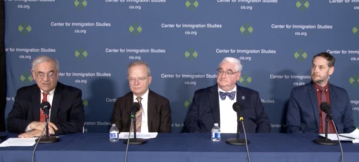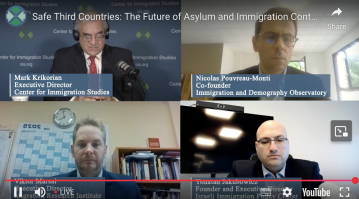
INIR held its third annual conference in Washington, DC on 6 November, 2025 with three panel discussions featuring INIR members and three keynotes delivered by guest speakers.
Former FBI Special Agent, former Chief of U.S. Border Patrol, and former Acting CBP Commissioner Mark Morgan’s keynote speech argued that today’s global migration crisis is driven less by humanitarian need than by policy incentives in destination countries. He framed border security as national security, claiming the U.S. enabled large-scale unlawful entry through “bad policy, bad politics,” judicial activism, and a media environment that “hijacks compassion.” The durable fix, in his view, is political and cultural: change public ideology, then lock in policy.
U.S. Senator from Missouri and former Missouri Attorney General Erik Schmitt’s keynote framed contemporary politics in the West around a popular demand to “take back control”. He contended that major changes in immigration policy and national identity proceeded without genuine democratic consent, and that elites suppressed dissent through censorship and technocratic gatekeeping. Pointing to opinion polls and to recent right‑of‑center policy shifts, he argued that Western nations are again learning to say “no,” reclaiming borders, identity, and self‑government.
In his video keynote, Christopher Landau argued that asylum, a narrow humanitarian carve-out born of World War II lessons, has evolved into a de facto mass-migration channel. In 2025, large volumes of weak claims overwhelm adjudication and delay removals, allowing most applicants to stay for years—thereby creating incentives for misuse and obscuring truly urgent cases. The aim, he said, is to ‘save asylum’ by restoring it to its limited purpose rather than abolishing it through overuse.
The panel ‘Asylum — What’s been done and what more is needed’ featured INIR members Mark Krikorian (Center for Immigration Studies), Yonatan Jakubowitz (Israeli Immigration Policy Center), and guest Rodrigo Ballester (MCC Center for European Studies). The panel contrasted two strategies to “fix” asylum. Krikorian argued that durable control requires withdrawing from the 1951 Refugee Convention/1967 Protocol and abolishing defensive asylum, replacing it with third‑country processing so that claims are made outside destination states. Jakubowitz agreed on the problems but contended countries can achieve nearly the same outcomes by returning to the Convention’s text and original intent: limiting rights to those lawfully present, expediting procedures, and enforcing removals and safe‑third‑country solutions. Ballester surveyed Europe.
The panel ‘Judicial obstruction of efforts to control immigration’ featured INIR members Matt O’Brien (Federation for American Immigration Reform) and Viktor Marsai (Migration Research Institute), and guest Simon Hankinson (Heritage Foundation). O’Brien surveyed the U.S., where nationwide injunctions, the Administrative Procedure Act, and settlements, together with statutory incentives, constrain detention, returns, and worksite enforcement. Hankinson outlined the UK experience, emphasizing rights-based challenges that stalled removal flights and complicated deterrence policies. Marsai broadened the lens to Europe, focusing on European Court of Human Rights (ECHR) jurisprudence, Court of Justice of the EU (CJEU) rulings, and national constitutional courts that limit border procedures and returns. Panelists called for clearer statutes, faster adjudication at the border, treaty and legislative reform where needed, and credible, lawful removals to restore control while preserving protection for genuinely eligible cases.
The panel ‘Political backlash to recent migration/asylum policies’ featured INIR member Jim Robb (NumbersUSA) and guests Marek Chodakiewicz (Institute of World Politics) and Kristóf Veres (Danube Institute). Robb argued that U.S. Hispanics shifted toward the GOP in part because of support for stricter immigration control, citing a large 2022 survey and recent validated‑voter findings. Chodakiewicz described a wider European cultural backlash reflected in support for parties like National Rally, AfD, and Vox, linking it to everyday safety concerns and perceived judicial or elite resistance. Veres traced the UK’s trajectory from the Brexit promise of control to persistent inflows—conditions aiding Nigel Farage’s rise.
Conference videos are available here.