by
Juan A. Soto
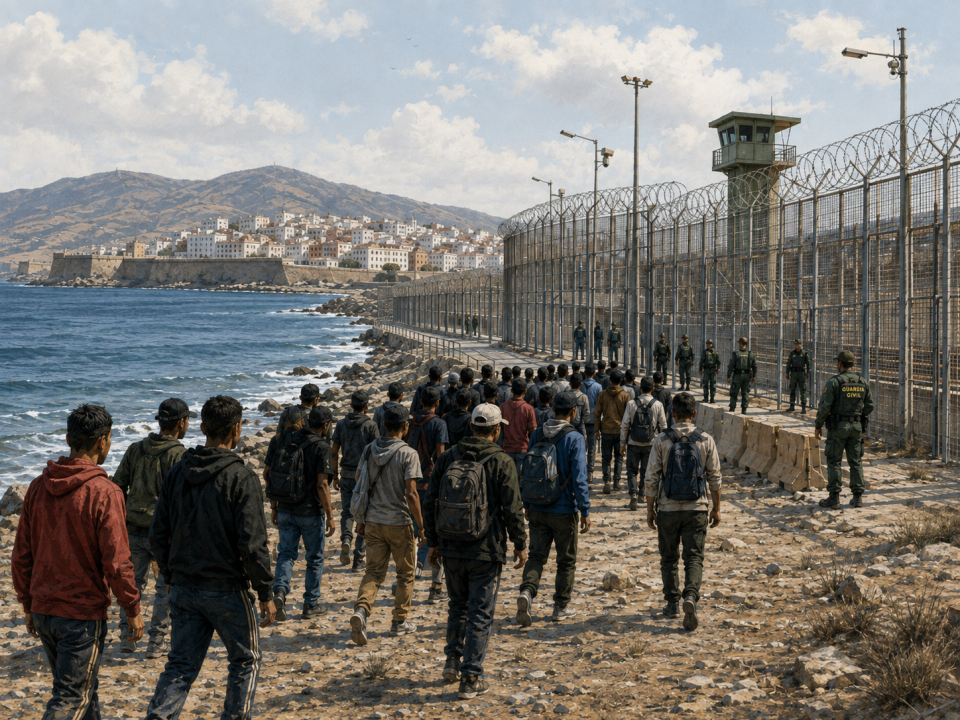
There is a moment in every one of these episodes when the vocabulary fails, and the failure is never accidental. On Thursday 30 July, 2026, people began entering the Spanish autonomous city of Ceuta from Moroccan territory in numbers no European frontier has absorbed in a comparable window: some 20,000 came within the first hours, and the number of arrivals approached 60,000 by Friday evening. The crisis spread overnight to Melilla, more than 48,000 returned to Morocco within two days, and at least 57 people drowned in the Strait. Ceuta has a population of about 85,000. Proportionally, the equivalent for the United States would be the entry of 200 million people in a day and a half. Within hours the event was given a name — a migration crisis — that determines everything that will now fail to be done about it.
It was not a migration crisis. It was a hybrid attack on the territory of a European Union member state, executed with people rather than munitions, and the people were the message rather than the message content. 48,000 of them were sent back within two days precisely because they were never the point.
The arithmetic settles this before any argument about motive begins. Irregular arrivals in Spain as a whole fell from 17,990 in the first half of 2025 to 12,138 in the first half of 2026, a decline of roughly a third; over the same period land arrivals at Ceuta rose from 978 to 2,582, an increase of about 164 per cent. Spain’s aggregate exposure was falling while its exposure at the single point of its perimeter where a foreign government controls access was rising sharply. Whatever is driving Ceuta is not driving Spain. Then there is the terrain: a double fence some ten meters high running for eight kilometers, monitored, and normally policed on the Moroccan side with considerable force — force that dispersed crowds of a few hundred at Fnideq within hours as recently as September 2024. The proposition that 60,000 people crossed that line in 36 hours without a decision having been taken to stand the enforcement down is not a proposition about migration. The tap was opened and the tap was closed. Both are decisions.
Countries have long used weaponized migration as a geopolitical instrument. By doing so, they commit no attributable act of force and can deny authorship to the end. Weaponized migration confronts the target with a choice between a humanitarian catastrophe and a political capitulation, and it uses the target’s own legal and moral commitments as the mechanism of coercion — which is why the instrument works best against precisely those states that take their obligations seriously. Ankara in the spring of 2020, moving people towards the Greek land border to extract concessions on the 2016 statement and on Syria. Minsk in 2021, organizing inbound flights from third countries and channeling arrivals towards Poland, Lithuania and Latvia in retaliation for sanctions. Rabat at Ceuta in May 2021, when nearly 10,000 crossed after Moroccan controls relaxed, at least 1,200 of them unaccompanied minors. And Rabat again now, at an order of magnitude beyond 2021 and compressed into a fraction of the time. Many episodes in less than a decade and, with the partial exception of Belarus, the instrument has worked every time.
It worked at Ceuta because it was cheap, and three things made it cheap. The first is Spanish migration policy, and here the criticism is deserved: an extraordinary regularization of over 1 million illegal migrants advertised across the Maghreb and the Sahel that entry is eventually rewarded, and a reception system at capacity that converts arrival immediately into visible crisis. I have written at length against both and would do so again. But this is the accelerant, not the ignition, and the distinction is not pedantic: a Spanish government that had never regularized a single irregular resident would still have been exposed on 30 July, because the exposure is not a function of what Madrid does with people once they are inside. The second is a judgment. On 29 June, 2026 the Spanish Supreme Court held that migrants arriving by sea at Ceuta and Melilla may not be summarily returned without due process, removing the administrative shortcut — the devolución en caliente — that had underwritten both perimeters for two decades. 31 days later the perimeter was tested at a scale never previously attempted. A state’s legal architecture is public; when a court narrows a removal power it publishes the fact, and that publication is, to any government contemplating pressure, an intelligence product delivered free of charge. It states on the record that the cost of an incursion has fallen and the probability of reversal has dropped. This is not an argument against judicial review of removal powers. It is an argument that the security consequences of such rulings are foreseeable, that they should be planned for in the interval between the judgment and the test, and that in Spain’s case they visibly were not.
The third is the one European colleagues have been slowest to say out loud. Coercion is priced. A government weighing an act of this kind asks what the target will do, what the target’s allies will do, and whether the act will be named for what it is — and anything that lowers that expected consequence makes the act more likely, whether or not the party doing the lowering intends the effect. On 30 July, the day the tap opened, the United States Department of State issued its Throne Day statement, reaffirming recognition of Moroccan sovereignty over Western Sahara, describing the autonomy proposal as the only basis for a settlement and declaring that any other path is unacceptable. The following day, with 57 people dead in the Strait, the Department posted that it stood with Spain against an egregious violation of Spanish sovereignty — and attributed that violation, in the same message, to the Spanish government’s own immigration policy. Set alongside months of escalating public signaling in Washington on the status of the North African cities, that is not coordination and I do not allege it. It is something more analytically awkward: an ally publicly reducing the anticipated cost of the act on the morning it occurred, and then declining, the morning after, to name it. Nothing in the public record supports a conspiracy. Nothing in the public record is needed for one. An outcome that serves a stated objective creates no incentive to prevent, deter or correctly name the act that produced it.
Which brings us to the part that should shock, and that has been discussed curiously little outside Madrid. Within twenty-four hours of an EU member state being coerced at the Union’s external frontier, Italy called for a suspension of Schengen free movement with Spain and closed its air and sea borders; Finland and Denmark signaled they were prepared to follow; France offered solidarity and quintupled its deployment on the Pyrenees; the Commission proposed Frontex reinforcement, called on Rabat to halt departures, and declined to speculate as to why the departures had occurred. Nothing whatever was suspended, threatened or reviewed with respect to the country that opened the border and facilitated the invasion. The EU’s first reflex was the containment and criticism of the victim rather than the deterrence of the actor.
I do not say the Italian government acted in bad faith, and there is a serious argument that a perimeter breached at this scale becomes, temporarily, a transit risk to its neighbors. My claim is narrower and harder to dispute: the rule applied to Spain has never been applied to anyone else. When Minsk channeled arrivals towards Warsaw and Vilnius, no Finn proposed suspending Schengen with Poland; Helsinki, which has closed its own eastern border under precisely this kind of pressure, understood the difference between a state being used and a state that is failing. When Lampedusa was overwhelmed, nobody proposed admonishing Italy for the permeability of its perimeter. When Athens faced the Evros in 2020, the Union eventually called it what it was. Every government now instructing Madrid has, within living political memory, asked Europe for exactly what Spain is asking for now and received it — usually with less loss of life and considerably less hesitation about what to call the act. Solidarity that arrives at the subsequent summit is not solidarity; it is commemoration. Deterrence lives in the first hours, because those are the hours the next actor studies.
And the next actor is studying. Denmark will want European support the next time Washington returns to the question of Greenland; a Union that answers the coercion of one member by containing that member has told Copenhagen in advance what its own file is worth. That is why attribution has to become routine rather than exceptional, so that naming an act of state coercion is not a diplomatic decision weighed against fisheries quotas each time; why the schedule of consequences — association-agreement provisions, tariff preferences, visa facilitation for officials, development instruments — has to be published in advance, since a consequence invented after the fact deters nobody while one known in advance is priced into the decision to open the tap; and why burden-sharing has to occur at the moment of the event, because a target that knows it will bear the cost alone is a target that will pay the coercer to make the problem stop. Spain paid in March 2022, with a letter to King Mohammed VI endorsing the autonomy plan, and was tested again last week. A concession extracted under duress is not a settlement. It is a demonstration, entered into the record, that the instrument works.
I am not optimistic that any of this will be built, and the reason is visible in the Commission’s refusal to speculate about motives. Attribution is cheap when the actor is Belarus and expensive when the actor is a partner on whom the Union depends for counter-terrorism cooperation, fisheries access and containment of the Atlantic route. Minsk was already a pariah; nothing was risked by saying what it did. Morocco is not, and so the same act, on a larger scale and with a higher death toll, produces from Brussels a call for both sides to act. That is the whole of the deterrence gap, and it is not an intelligence failure or a capability failure. Everyone involved knows what happened at Ceuta. Everyone involved has the tools to respond. What is missing is the willingness to attach consequences to a category of action we have already correctly identified, named and analyzed — compounded here by the discovery that some of those consequences would have to be attached to ourselves.
Instruments that are cheap, deniable and effective do not fall into disuse. They are studied, and they are adopted by others. The question is not whether this happens again, but where, against whom, and whether the target will have thought about it beforehand.
© 2026 INIR. All rights reserved.
The article reflects the author’s personal views.
INIR does not take institutional positions on public policy issues; the views represented herein are those of the author(s) and do not necessarily reflect the views of INIR, its staff, or its trustees.